

Racial Disparities in Cincinnati Police Stops
Campaign Zero’s report finds that Cincinnati Police stop Black people 3.4x more often than White people. These disparities are explained by the whiteness of a neighborhood, not by crime rates.


Campaign Zero has launched a first-of-its-kind website to share its report and review of racial disparities in police stops in Cincinnati.
Twenty-five years after protests yielded a Collaborative Agreement between the City, police, and community, we analyzed over 400,000 discretionary police stops from 2009 - 2025 to answer the question: is policing in Cincinnati racially equitable? The answer is no.
Cincinnati Police Department (CPD) data shows in 2025:
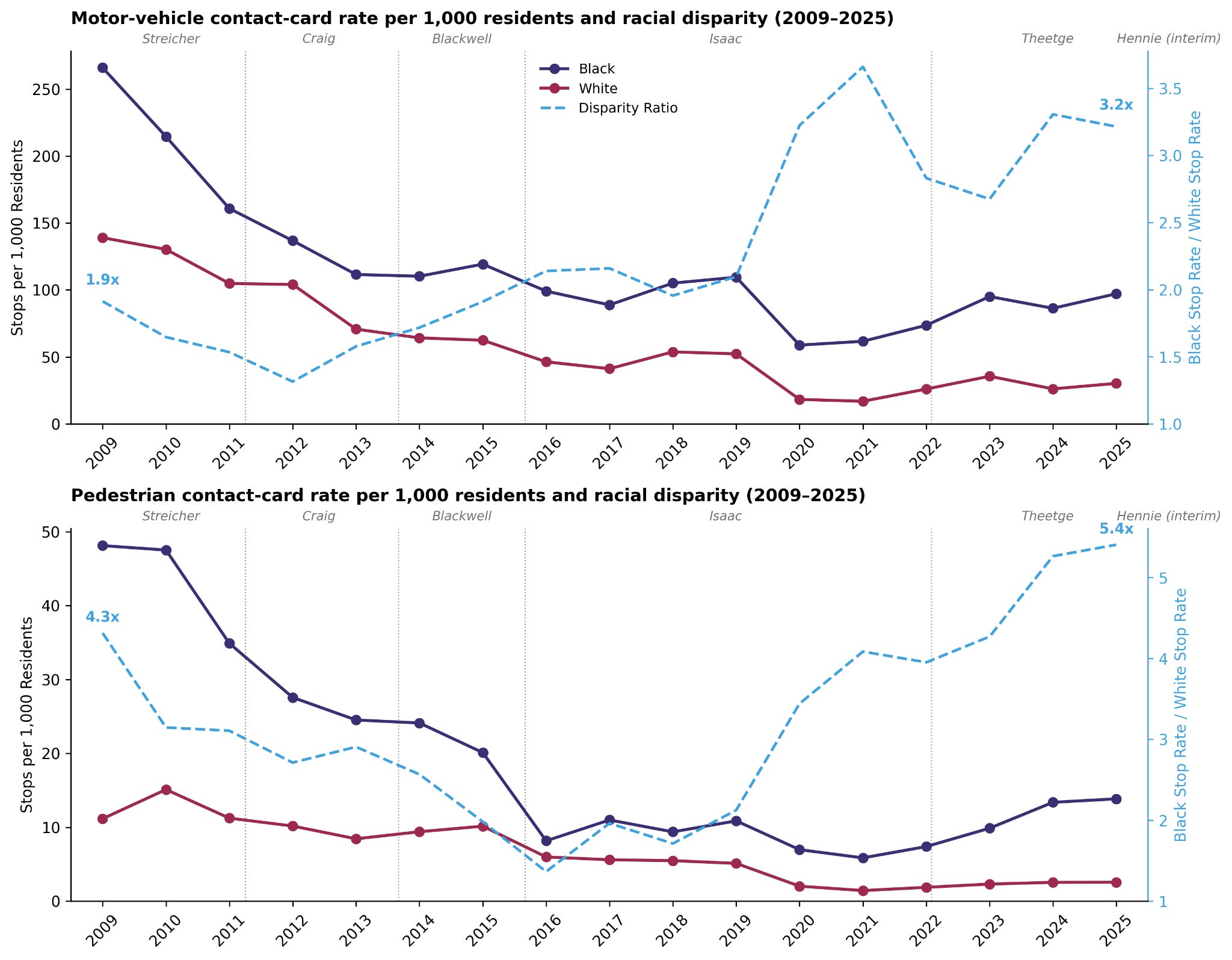
Cincinnati Police officers stopped Black people 3.4x more often than White people.
Cincinnati Police officers stopped Black pedestrians 5.4x more often than White pedestrians.
Cincinnati Police officers stopped Black people in vehicles 3.2x more often than White people.
Disparities Explained By the Racial Composition of the Neighborhood, Not By Crime
Our review of 17 years of data found that crime levels are not a predictor of racial disparities in discretionary stop decisions made by Cincinnati police officers. The strongest predictor is the whiteness of a neighborhood.
In majority White neighborhoods:
Black pedestrians are stopped by Cincinnati Police 4.5x more often than White people
Black motorists experience discretionary traffic stops 5.5x more often than White motorists.
The more White the neighborhood is, the more likely it is for a Black person to be stopped there. Crime rates do not explain this trend.
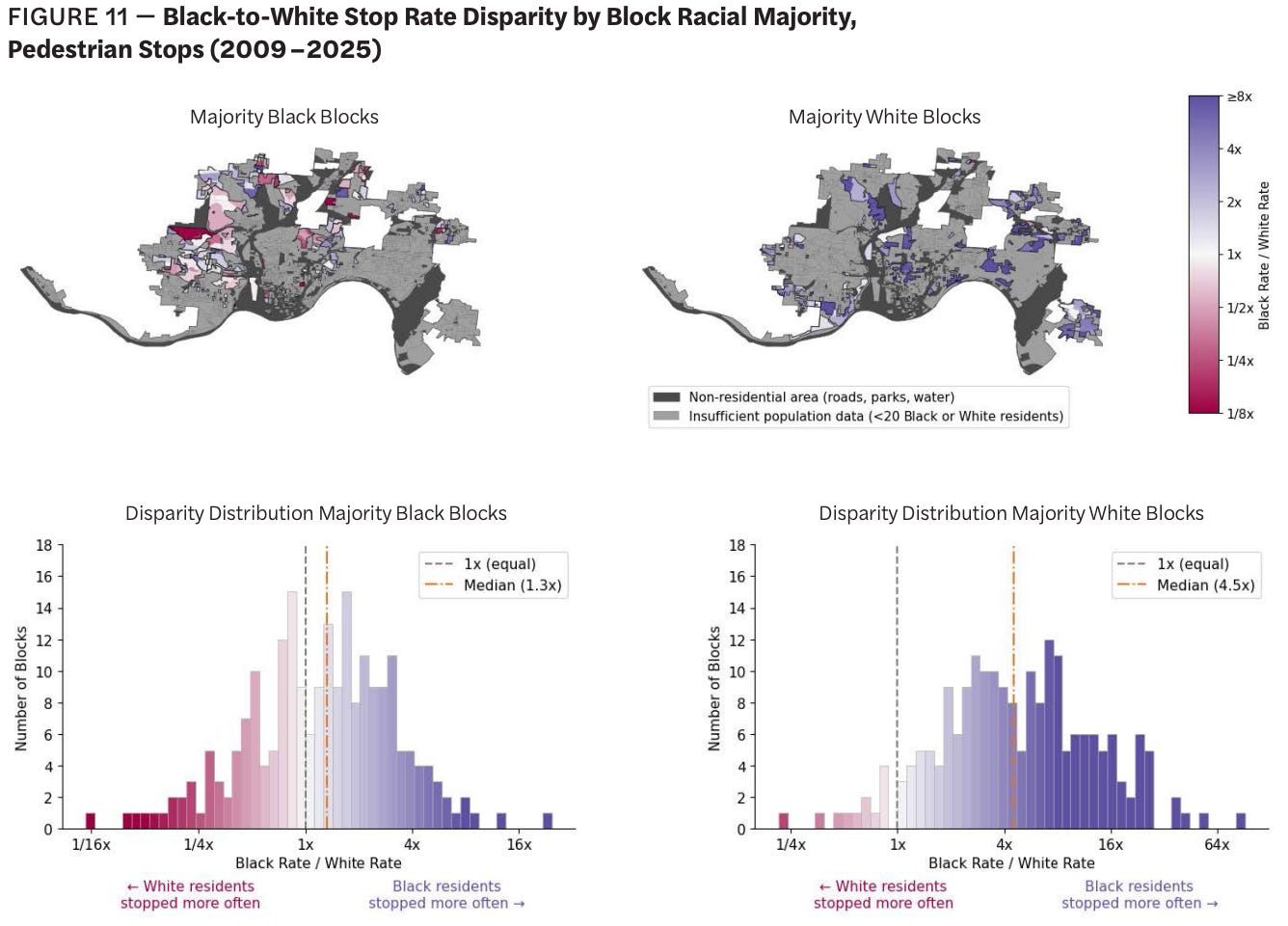
This finding does not hold for White people in Black neighborhoods – the rate of stops for Black and White people in Black neighborhoods are nearly equal (a 1.1x disparity for motor vehicle stops and 1.3x for pedestrian stops).

How to Explore the Website
Our website has several interactive features to make this comprehensive dataset accessible and easy to understand.
Overview of our findings. We provide a high-level summary of our findings. See how much more often Black people are stopped, searched, experienced force, and arrested.
Download the data. Part of our commitment to the community is to always share the data. Public data should be public. Download the data to further explore the trends on your own.
Read the report and report addenda. The foundation of this project is our thorough review and analysis of police stops in Cincinnati. Read the report for detailed analyses of factors not featured elsewhere on the website, including a time of day analysis, initial reasons for stops, and stop outcomes. We’ve also included an addendum that features data findings resulting from community and city officials’ requests for additional analyses, an addendum on task forces, and a review of previous reports on contact card data before 2009.
Learn more about contact cards. Discover more about the history of contact cards in Cincinnati and how they were born from a Collaborative Agreement between the City, police, and community.
Use our interactive maps to view disparities at the neighborhood, census block, and street level. We’ve built a series of maps for users to view police stops across the city. View individual stops down to the street level or interact with disparity maps similar to those found in the report.
Engage with the police officer database and sort to see officers with the most racially disparate stops. Search the name of any officer who filled out a contact card in Cincinnati between 2009 and 2025 and view their stops, how often they use force, how often they arrest someone, etc.
Read our policy recommendations. We make nine recommendations for addressing racial disparities in police stops, improving contact card data collection, and driving policy change in Cincinnati.
Contact city officials and demand action to address racial disparities. Emails are provided for Mayor Pureval, City Manager Long, and members of City Council.
Local to Cincinnati? Get Involved
Cincinnati community leaders are hosting upcoming community forums:
Tuesday, June 30, 6:00-8:00 PM ET
Truth and Destiny Covenant Center
2645 W North Bend Rd, Cincinnati, OH 45239
Tuesday, July 14, 6:00-8:00 PM ET
Holloman Center for Social Justice (Urban League)
3539 Reading Road Suite 100, Cincinnati, OH 45229
Share the Data
If you have friends or loved ones in Cincinnati, forward them this email or share the link! All data is available at contactcards.org.
Engage with our interactive maps, look up specific officers, and demand policy change from city officials.
Learn More About Contact Cards
If you’re unfamiliar with the City of Cincinnati’s use of contact cards and the history behind the requirement, check out these resources:
 | A guest post by
|
I'm absolutely fine with going back to loud discussions of defunding the police in the US - especially because it appears increasingly vital to preserving our nation.