

Labeled for Life: Ending the Era of Gang Enhancements
Across 37 states and the District of Columbia, you can spend decades in prison for who police say you are.


When federal agents raided K. Lewis’s campus apartment in the middle of the night, he was 22 years old, asleep with his young son, and only a semester away from attaining his Master’s degree in Criminal Justice. He had no criminal record. He wasn’t accused of committing a specific crime. But he had grown up in the Bronx, and some of his childhood friends were people the police had been watching. That was enough. Lewis was swept into a federal gang indictment alongside 120 others—labeled a “gang member” based on social media posts, music videos, and wiretaps.
“I spent 22 months in jail with no criminal record and no evidence of a crime,” Lewis said. “I shouldn’t be in the same facility as El Chapo.”
A federal judge ultimately rejected the five-year plea agreement prosecutors had pressured Lewis to accept, but the damage was done–his educational pursuit was derailed, and employment has been hard to find since being released from jail. Of the 120 people indicted alongside him, 115 accepted plea deals rather than risk going to trial. Lewis’s story is not an exception. It is how the system is designed to work.
What Are Gang Enhancements?
Gang enhancement laws allow prosecutors to add years—sometimes decades—to an individual’s criminal sentence based on who police claim they are, NOT on what they did. These ‘enhancements’ exist in 37 states, Washington D.C., and at the federal level, meaning people in virtually every state can be affected. Because federal enhancements apply nationwide, no state is truly exempt.
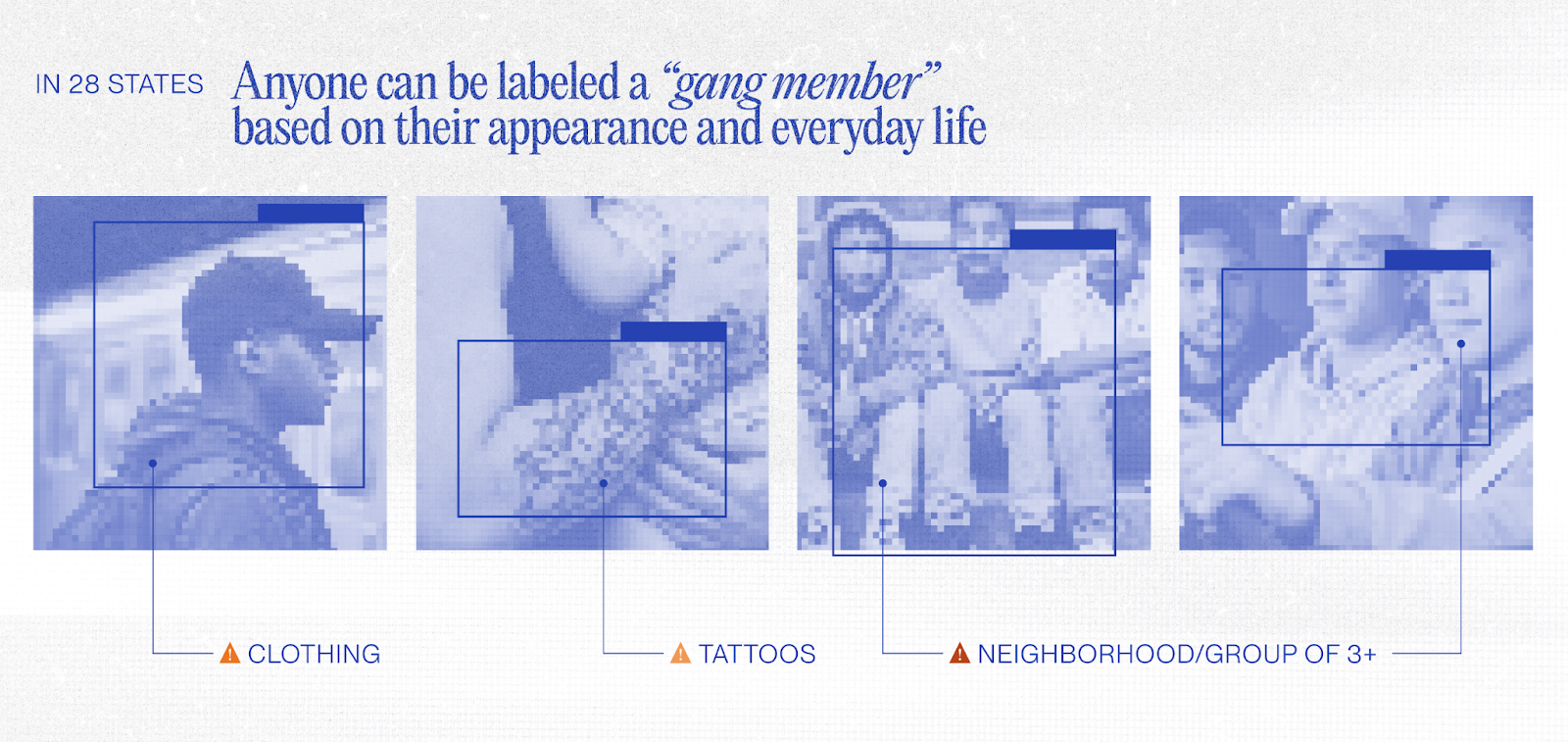
These laws rarely require proof of organized criminal activity. Instead, gang affiliation is typically established using subjective indicators—clothing, tattoos, social media activity, neighborhood ties, or simply associating with people police suspect of gang involvement.

In 28 states, these kinds of subjective identifiers are explicitly written into the law as permissible evidence of gang membership. For example, in South Dakota, the criteria used to establish gang membership are:
SDCL § 22-10A-1: Section 22-10A-1
(1) “Street gang,” any formal or informal ongoing organization, association, or group of three or more persons who have a common name or common identifying signs, colors, or symbols and have members or associates who, individually or collectively, engage in or have engaged in a pattern of street gang activity;
(2) “Street gang member,” any person who engages in a pattern of street gang activity and who meets two or more of the following criteria:
(a) Admits to gang membership;
(b) Is identified as a gang member by a documented reliable informant;
(c) Resides in or frequents a particular gang’s area and adopts its style of dress, its use of hand signs or its tattoos and associates with known gang members;
(d) Is identified as a gang member by an informant of previously untested reliability if such identification is corroborated by independent information;
(e) Has been arrested more than once in the company of identified gang members for offenses which are consistent with usual gang activity;
(f) Is identified as a gang member by physical evidence, such as photographs or other documentation; or
(g) Has been stopped in the company of known gang members four or more times;
Determinations are often made by police officers presented in court as “gang experts,” with no formal credentials beyond their law enforcement experience—a practice legal scholars have identified as a violation of defendants’ due process rights.
The definition of a “gang” is also strikingly broad. In 31 states, a gang is legally defined as a group of three or more people. In Arizona, Maryland, and Nevada, the threshold is only two or more people. That means a pair of friends can qualify. Once a label is applied, the consequences are severe.
Enhancements can add anywhere from 1 to 99 additional years to a sentence, depending on the state. Twenty-one states allow enhancements of 20 years or more, and seven states permit life without parole via enhancement alone. Nationally, the average maximum enhancement adds roughly 23 years to a prison sentence.
In most states, enhancements can be applied to any criminal offense—not just violent felonies. Only Ohio limits its use to violent felony offenses.
These laws rarely require proof of organized criminal activity. Instead, gang affiliation is typically established using subjective indicators—clothing, tattoos, social media activity, neighborhood ties, or simply associating with people police suspect of gang involvement.
How the Label Shapes the Entire Legal Process
Gang enhancements don’t just affect sentencing; they reshape every stage of the legal process.
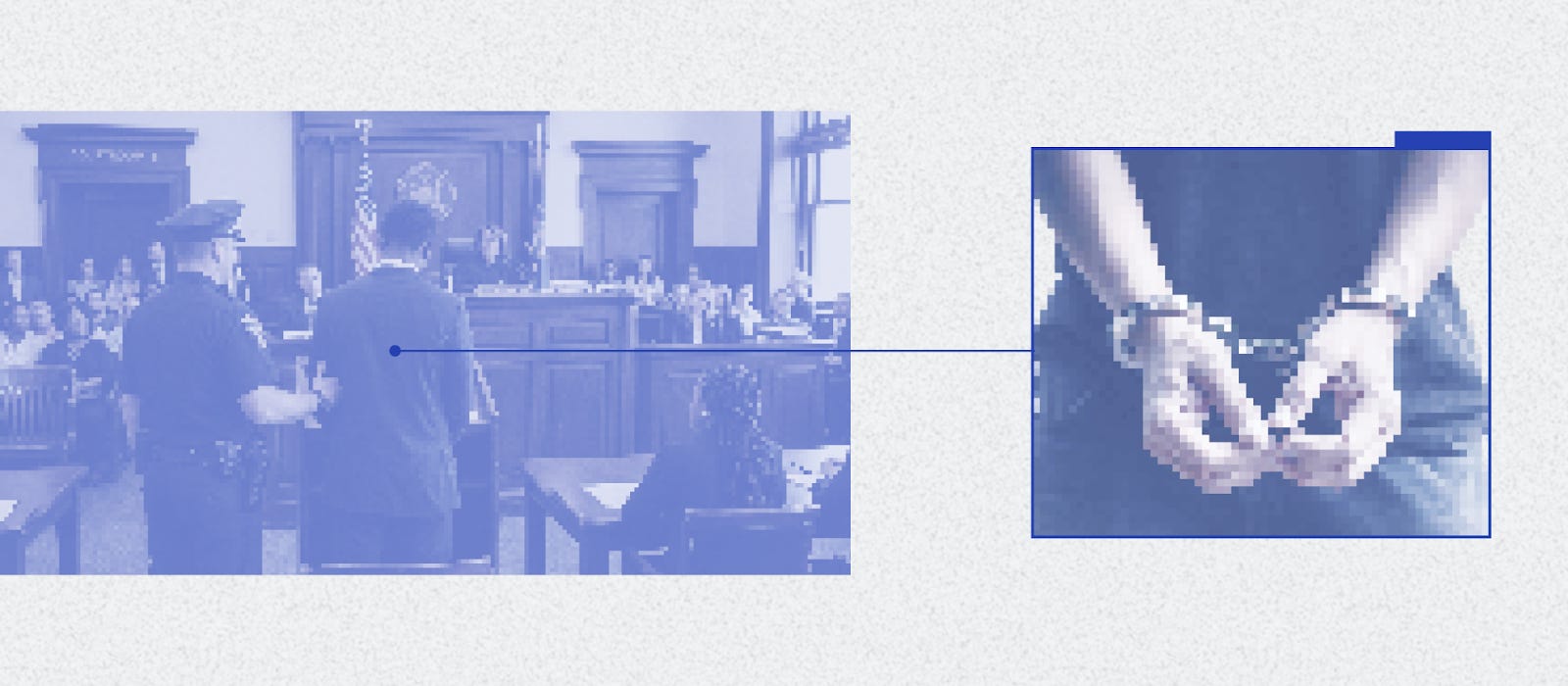
Prosecutors typically introduce enhancement allegations at the charging stage, using the threat of decades of additional prison time as leverage to pressure defendants into accepting plea deals. This tactic works. Because most enhancements are deployed at the charging stage rather than at trial, the true scope of how often they are used is almost certainly underreported — many cases disappear into plea agreements before they ever reach a courtroom.
For those who do go to trial, research shows, the “gang” label itself becomes a liability. Multiple peer-reviewed studies have found that informing jurors of an alleged gang affiliation significantly increases the likelihood of a guilty verdict—even when reasonable doubt has been clearly established (Eisen 2014, Howell 2010).1 This is because the word “gang” triggers associations with premeditated, senseless violence that can override the evidence actually presented. As one public defender put it, these cases become “a trial of the gang rather than a trial of the individual” (Galvin-Almanza 2019).2 Prosecutors introduce evidence about other alleged gang members — people the defendant may barely know — and the person on trial gets lost in the narrative.
Prosecutors typically introduce enhancement allegations at the charging stage, using the threat of decades of additional prison time as leverage to pressure defendants into accepting plea deals.

Who These Laws Target
The racial disparities in gang-enhancement enforcement are stark and consistent. In California, 92% of gang enhancement convictions involve Black or Brown defendants. Approximately 6% of all people serving time in California prisons carry a gang enhancement conviction—and the overwhelming majority are people of color.
This is not coincidental. The disparities reflect the origins of these laws. Gang enhancements trace back to California’s Street Terrorism Enforcement and Prevention (STEP) Act of 1988, passed at the height of the tough-on-crime era. From the start, the targeting was explicit: that same year, the California Attorney General circulated a handbook describing Black men between the ages of 13 and 40 as likely gang members based on personality traits and style of dress. California’s law became the national template, and the racial logic embedded in it traveled with it.
And the harms of these laws don’t end with harsh sentencing enhancements. Underlying the entire system is an infrastructure most people don’t know exists: gang databases. Law enforcement agencies across the country maintain lists of people designated as suspected gang members or associates, and the criteria for inclusion are as loose as those used for sentencing enhancements. People can be added to gang databases based on where they live, what they wear, who they spend time with, or what they post online — without committing a crime, without being notified, and without any meaningful way to challenge the designation.
The scale of these databases is significant. In the Los Angeles County gang database alone, approximately half of all Black men between the ages of 16 and 24 are listed as gang members or associates. Chicago’s database contains over 128,000 adults and tens of thousands of children, some as young as nine, with Black individuals comprising 70% of those listed. A 2023 Inspector General’s report found that New York City’s database is 99% Black and Hispanic—despite research showing that gang membership is substantially more common among white youth than law enforcement statistics suggest.
Law enforcement agencies across the country maintain lists of people designated as suspected gang members or associates, and the criteria for inclusion are as loose as those used for sentencing enhancements.
Once someone is included in a database, the consequences extend far beyond the courtroom. Gang designations affect employment, housing, and immigration status — often for life. In recent years, federal immigration authorities have increasingly relied on these databases to identify people for detention and deportation. A label applied without due process by a local police officer can result in someone being removed from the country entirely.
Walter Ramirez, a Chicago resident, was targeted by ICE after being entered into the city’s gang database twice—listed as a member of two rival gangs based on two minor, unrelated police encounters. He was released only after the city admitted the error.
Do These Laws Actually Work?
Supporters argue that gang enhancements deter crime and disrupt dangerous organizations. However, emerging scholarship finds that gang enhancements do not reduce violent crime and have no deterrent impact in general (Yoshino 2008, Marston 2019, Kennedy 2009).3 Research has consistently found no clear relationship between gang enhancement laws and reductions in crime or gang activity (Van Hofwegen 2009).4
Some studies suggest the opposite may be true: harsher sentences can strengthen gang ties inside prison and increase recidivism, as people are forced to rely on those networks to survive incarceration (Van Hofwegen 2009). A 2004 study of incarcerated gang members in Illinois, found that incarceration actually increased the likelihood of reoffending by reducing the chance that individuals would age out of gang involvement on their own (Olson, Dooley, Kane, 2004).5
Meanwhile, researchers note that traditional gang structures have been deteriorating since the 1990s, and that law enforcement strategies built around conspiracy-style prosecutions of hierarchical organizations are increasingly out of step with how urban social networks actually operate today (Marston 2019).6
Research has consistently found no clear relationship between gang enhancement laws and reductions in crime or gang activity.
What these laws demonstrably accomplish is diverting resources away from strategies proven to reduce violence: community investment, violence interruption programs, and youth opportunity initiatives. Rather than addressing the conditions that give rise to harm, gang enhancements criminalize social networks and punish identity.
What We’re Doing About It
Today, Campaign Zero is launching Labeled for Life—a national campaign to end gang enhancement laws and dismantle the databases that sustain them, beginning in California, Illinois, Georgia, Maryland, and Washington state, where some of the country’s harshest laws remain on the books.
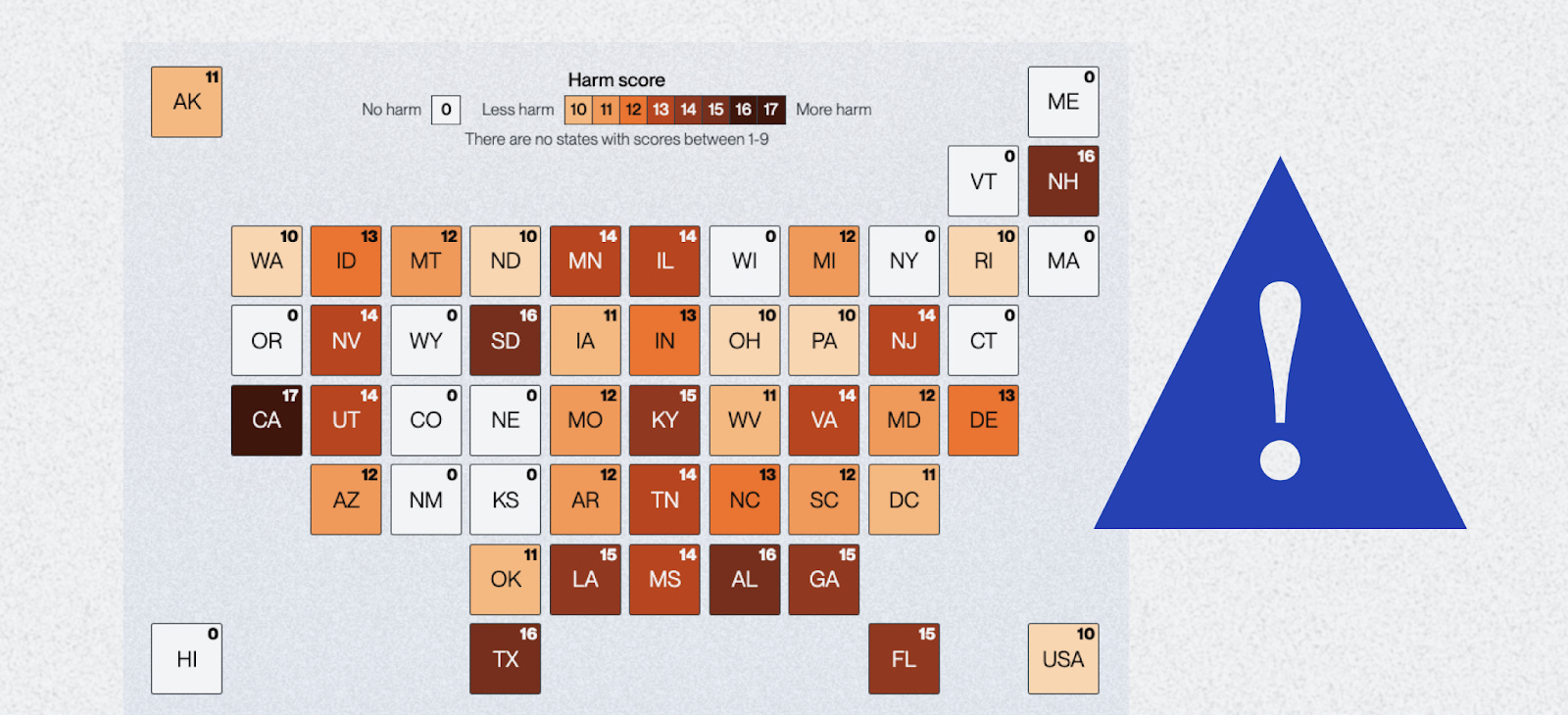
At the center of the campaign is the Harm Index, an interactive tool that scores every state’s gang enhancement laws across three dimensions: the severity of sentencing enhancements, the breadth of gang membership definitions, and the extent to which due process protections are afforded to defendants. The goal is to make the hidden consequences of these laws visible—and to give advocates, policymakers, and everyday people the information they need to push for change.
A justice system that enforces consequences based on who people are rather than what they did is not justice. It is racial profiling with an enhanced sentence attached.
Eisen, Mitchell, Dotson, Brenna, & Dohi, Gregory. “Probative or Prejudicial: Can Gang Evidence Trump Reasonable Doubt?”. (UCLA Law Review 62 DISC. 2, 4, 2014).
Howell, K. B. (2010). Fear itself: The impact of allegations of gang affiliation on pre-trial detention. Thomas L. Rev., 23, 620.
Galvin-Almanza, Emily. “California Gang Laws Are Normalized Racism.” The Appeal, October 4, 2019.
Yoshino, Erin R. “California’s Criminal Gang Enhancements: Lessons from Interviews with Practitioners.” (Southern California Review of Law and Social Justice, vol. 18 no. 1, Fall 2008).
Kennedy, David M. “Gangs and Public Policy: Constructing and Deconstructing Gang Databases.” (American Society of Criminology, 2009).
Van Hofwegen, Sara Lynn. “Unjust and Ineffective: A Critical Look at California’s STEP Act”. (Southern California Interdisciplinary Law Journal [Vol. 18:679], 2009).
Olson, D. E., Dooley, B., and Kane, C. M. “The Relationship Between Gang Membership and Inmate Recidivism.” (Illinois Criminal Justice Research Authority, 2004).
Marston, Rebecca J. “Guilt by Alt-Association: A Review of Enhanced Punishment for Suspected Gang Members”. (University of Michigan Journal of Law Reform, 2019).
Now would be a great time for the Democrats to fight back against this horrifying injustice, though I can appreciate the optics of doing so, and I hope there is a special circle in Hell for whoever came up with fear mongering as a replacement for critical thought, as that is how we ended up here.
Love this! Thank you for bringing light to this, and for all the work you guys are doing!